


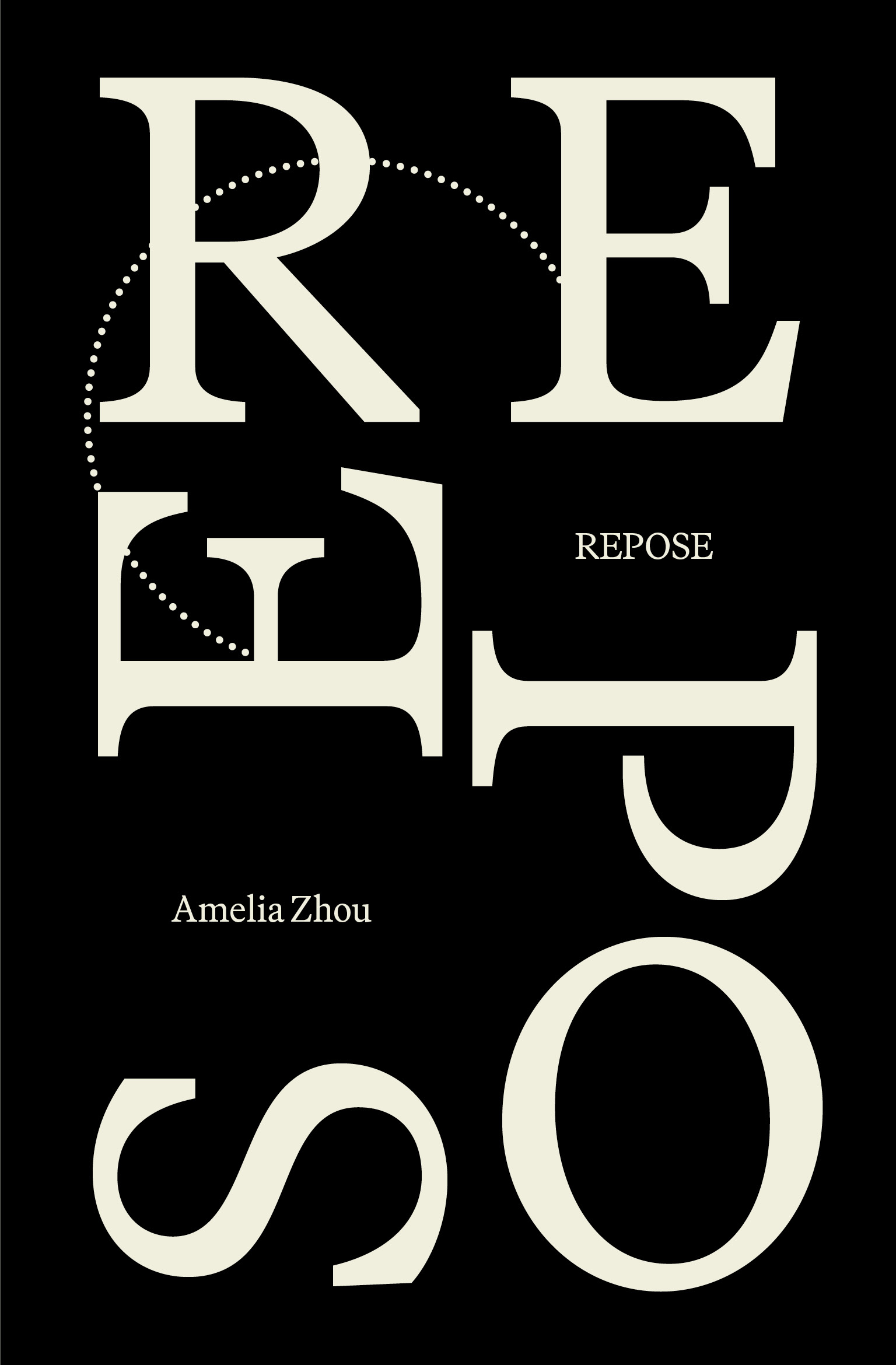
October 2024
Passage Series #6
Design by Dorothy Lin
Softcover, 120 pages, 8 x 5.375 inches
ISBN: 979-8-9909878-0-7
Edition of 1,000
18 USD
About the book
In her debut book, Amelia Zhou poses the question, “How do I perform or not perform?” Weaving together poems, fiction, and lyric essay, Repose follows an unnamed woman grappling with the limits of the self on the everyday stage of labor and routine, charting her emergent modes of resistance. She is already steps ahead, deftly shifting between worker and dancer, roving through the haunted space in which a performance has just ended, the ruins of a house, or a skyscraper aflame. Seeking the edges of form—where it exceeds itself, where it breaks down—Repose offers a narrative of girlhood invigorated by the mutual possibilities of dreaming and defiance.
Amelia Zhou's Repose is the 2022 Open Reading Period Book Prize winner, and was selected by guest judge Asiya Wadud.
About the author
Praise
Real estate agent, surgical patient, ballet dancer, baby raiser... In Amelia Zhou’s layered, lucid, and dream-suffused Repose, performing professionals remind us that the girl’s vocation remains the management of (her) appearances. As “second bodies,” these figures hover and break apart, like a “mouth now wandering away.” Following the paths of their roving weirdness, Zhou’s poetics alert us to some other more sublime task. “To bloom out the ragged bud.” To notice the “furious dignity” in all her/our many scraps and shreds.
—Lauren Bakst
Amelia Zhou’s Repose is a work of measured reflection: it is also a work that is as full of movement and intelligence as the two mediums that Zhou invokes throughout the book, cinema and dance.
—Aurelia Guo
Early on in Amelia Zhou’s Repose, the speaker asks the reader, “Do all lost things live in ruins?” Ruins—as in aftermath, as in refuse, as in the rotting and wilted physical landscape—permeate this deft and roving collection of poems. Zhou’s work rests in the fleeting space of bodies in motion, the friction of bodies troubling and inhabiting spaces across planes and distances. Zhou does not attempt to still this movement. Instead, she allows it to fold and create its own repetitions, logic, and accord. Along the way, Zhou opens up a space for the spectral.
—Asiya Wadud
Press